

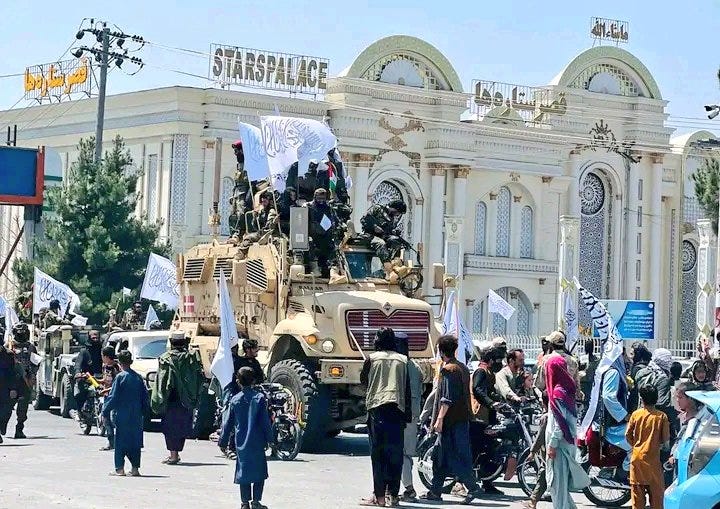
Before seizing power in mid-August 2021, the Taliban promised education for all and respect for fundamental human rights. However, after taking control, they gradually began deviating from these commitments, instead imposing their extremist ideology. This shift has been marked by a series of oppressive measures, including banning secondary and university education for females, dissolving civil society, prohibiting women from working, and denying women's public participation.
The recent law of Vice and Virtue punishes women even within the confines of their families if their voices are heard outside, further illustrating the expansion of the Taliban's systematic and abusive tactics in the personal sphere.
These measures will have severe and far-reaching consequences for Afghanistan and beyond. The essay argues for coordinated and unified efforts to combat the Taliban's discriminatory practices and to improve the education and human rights situation in Afghanistan.
The Taliban’s Promises
In early 2019, during a news conference in Moscow, a prominent Taliban delegate, along with other senior members of the group, stated that under their regime, girls would be allowed to pursue education up to the doctorate level and would be permitted to work. This assurance was consistently echoed by all the delegates, who sought to convince the Afghan people and the international community that their return to power would be markedly different from their previous rule.
“girls would be allowed to pursue education up to the doctorate level and would be permitted to work”
The Taliban's statement, along with other promises they made, ignited optimism among certain regional actors. This optimism led to the belief that the Taliban had undergone a significant transformation, distancing themselves from their past actions. Some argued that despite the substantial risks involved, the Taliban could be trusted to uphold their promises, given their recent assurances. As a result, parties engaged in dialogue with the Taliban, choosing to proceed on the assumption that the Taliban had indeed changed.
Contradiction Between Promise and Practice
The three years of their rule upon their return in mid-August 2021 have proven the promises wrong and conveyed a stark divergence from these early commitments. The Taliban's continuous breach of their commitments has become evident. Over these three years, they have issued dozens of decrees and directives, collectively erasing girls and women from public life. The only vestige of educational access for girls remains in primary schools, which, in some provinces, have reportedly seen a ban on community classes for young girls. Most recently, in Khost province, a ban was ordered on teaching through radio broadcasts.
Despite widespread condemnation and demonstrations by both the Afghan people and the international community, the Taliban's response has been one of brutal suppression. Over 10,000 civil society organizations have been dissolved1, many of which predated the Taliban movement by decades, with roots back centuries. The Taliban have systematically targeted and punished civil society activists and anyone who opposes their ideology, including the arbitrary detentions of women and girls. This has been accompanied by extensive media censorship and tight control over information.
In contrast to their repression of civil society, the Taliban have expanded their network of Madrasas to 15,000 with 100,000 instructors, established religious councils, and bolstered their control through intelligence, police, and related administrations2. Thousands of their followers have been credentialed and recruited as lecturers in schools and universities to propagate their ideology.
This suppression has occurred under the watch of a fragmented and contradictory international diplomatic response. Some regional countries, including China, Russia, Iran, Pakistan, Uzbekistan, and the United Arab Emirates, have recently formalized relations with the Taliban and accepted their diplomats. Unfortunately, short-term political interests often drive these diplomatic engagements, undermining international efforts to hold the regime accountable for human rights.
The Taliban have effectively exploited international conflicts to undermine the credibility of countries advocating for human rights in Afghanistan, using this as a pretext to continue their atrocities against the Afghan people. This has encouraged the regime, fostering a belief that despite their actions, they will eventually gain international acceptance and legitimacy, further fueling their extremist agendas.
The Taliban’s Arguments
The Taliban's interpretation of Islam is inextricably linked to their political ideology and their pursuit of long-term political dominance. They view deviations from their beliefs as unacceptable and warranting strict punishment. This interpretation finds little support within the broader Muslim community, with many actively opposing their views.
A central issue for the Taliban is the role of women in society and how this will affect their grip on power. This question divides them into two primary factions. The first faction, which includes the regime's supreme leader and other influential figures, supports a complete ban on girls' and women's education. They argue that even tightly controlled education could lead to changes that would undermine their authority, citing the observed correlation between higher levels of education in urban areas and lower levels of support for the Taliban.
The second faction, with a more nuanced understanding of global affairs, suggests a compromise: allowing girls' education to continue under strict Taliban supervision. They propose transforming schools into semi-jihadi madrasas, altering the curriculum and learning environment. This approach, they argue, would appease international pressure while still advancing the Taliban's ideological goals. However, this moderate view faces resistance from extremist elements within the regime, who currently hold sway in decision-making.
Both options have dire consequences for the Afghan people. While the approaches differ, they share the same ultimate goal: curtailing free and equitable education.
The Recent Escalation of Suppression
A devastating parallel emerged on August 24, 2024, the anniversary of the 2016 Taliban attack on the American University of Afghanistan. While the 2016 attack resulted in tragic casualties, the 2024 one was equally troubling with long-term consequences: the Taliban introduced a new law granting the Ministry of Vice and Virtue extensive authority to investigate, prosecute, and punish women for failing to comply with strict dress codes, speak out, limiting their public interactions, or associating with non-Muslims. This law also targets individuals who wear non-Muslim attire or create or watch images and videos depicting living beings.
The following day, on August 25, the Taliban's Minister of Higher Education announced the possible permanent closure of schools and universities for girls3. He also declared that Afghans would be prohibited from studying abroad in countries that do not align with the Taliban's beliefs4.
With these actions, the Taliban have solidified their place among the most extreme ruling groups, surpassing even the most radical organizations in their repressive measures. They have effectively crushed any hopes for dialogue or negotiation.
The escalating crisis in Afghanistan is no longer an isolated internal issue. Its destabilizing effects are rippling outward, fueling extremism and organized crime on a global scale. The recent terrorist attacks and surge in criminal activity are merely harbingers of a broader threat. Ignoring this crisis is a short-sighted and costly gamble. The consequences – from heightened terrorism to increased instability – will ultimately impact us all. It is a global challenge that demands urgent attention and decisive action.
Taliban’s Ministry of Justice. (n.d.). Decree on the dissolution of civil society.
Based on the Taliban’s decrees, 2024.
TOLOnews. (2024, August). Based on the Taliban’s Minister of Higher Education press conference briefing [Tweet]. X (formerly Twitter). https://x.com/TOLOnews/status/1827607537530892786
Hafiz Zeiya. (2024, August 25). Based on the Taliban’s Minister of Higher Education press briefing [Tweet]. X (formerly Twitter). https://x.com/HafizZeiya/status/1827642537676353933