

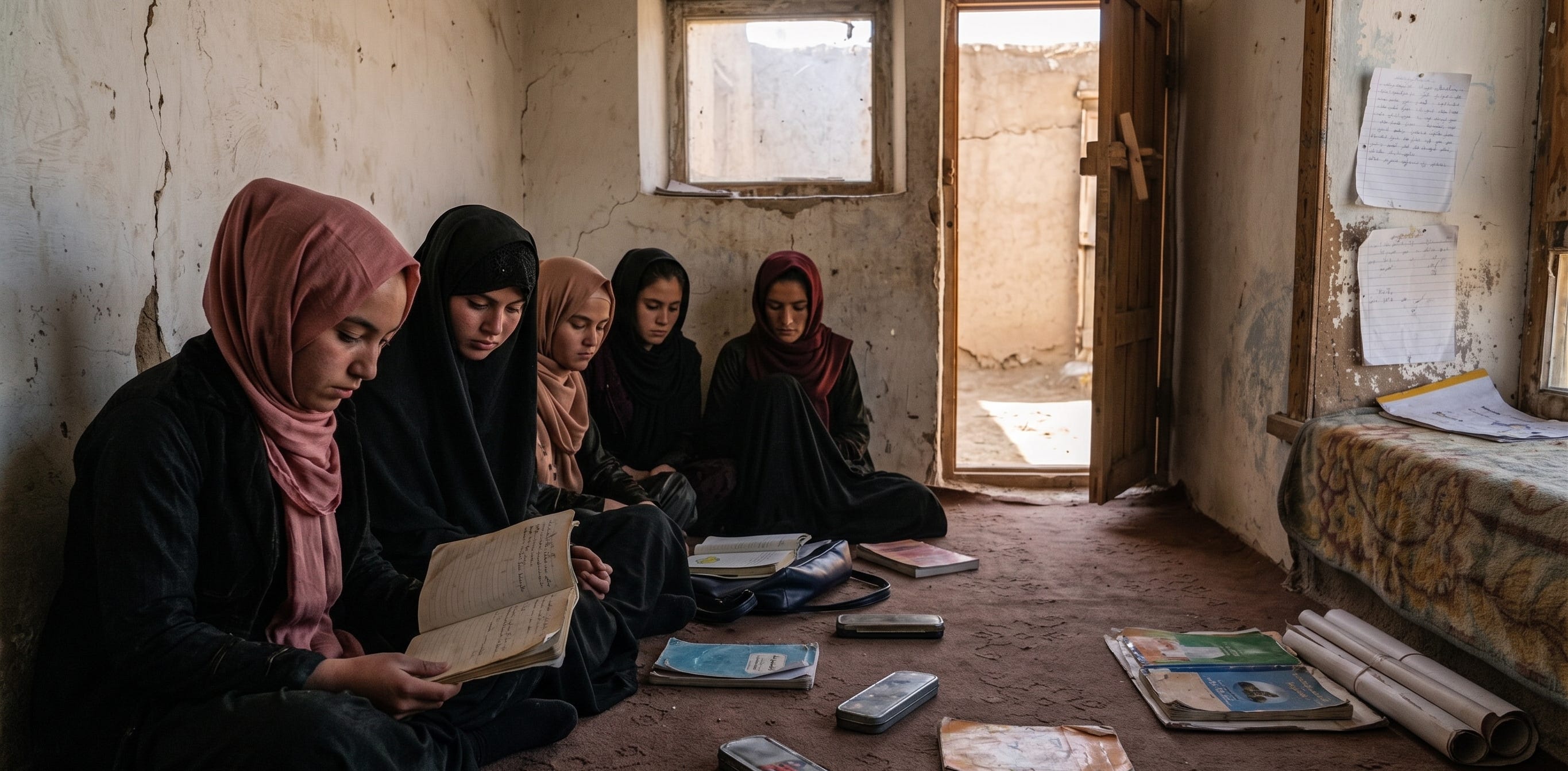
A significant challenge in current advocacy for girls’ right to education in Afghanistan is the growing disconnect between how the crisis is framed and its actual evolution. Much of the advocacy discourse, policy commentary, and public campaigning still largely reflect the situation of 2021, when the Taliban barred girls from accessing education beyond primary levels. The primary proposed solution remains the removal of this ban to allow girls to return to secondary schools. While this framing was relevant at the onset of the ban, it has become increasingly misaligned with the ongoing realities of the crisis.
The issue is not that this framing is incorrect; it is simply incomplete and increasingly insufficient. By viewing the crisis primarily as an access issue, the advocacy community risks addressing a problem that has transformed. The situation in 2026 is qualitatively and quantitatively different from that of 2021. Yet, advocacy narratives often continue to emphasize the immediate need to reopen schools and universities, assuming that lifting restrictions will allow the education system to function as it did before. Such assumptions overlook the cumulative effects of prolonged exclusion, the emergence of a significant educational backlog, the deterioration of educational institutions, and the changing nature of the education system under Taliban rule.
Thus, the problem in 2026 is not merely the continuation of the 2021 ban; it is the accumulation of multiple interconnected educational crises that have developed over time. Initially, when the Taliban imposed restrictions on girls’ secondary education, the policy demand was straightforward: girls should be allowed to return to school. At that time, the number of girls affected by the closure was relatively small. According to UNESCO, around 300,000 girls of secondary-school age were impacted when grades 7–12 were closed in 2021–2022.
However, the scale of exclusion has since expanded dramatically. Each year that restrictions remain in place, new cohorts of girls complete primary education and enter a blocked educational pipeline with no access to secondary schooling. Consequently, the crisis has become cumulative rather than static. UNESCO reported in 2024 that approximately 1.4 million girls had been deprived of secondary education since the Taliban takeover, with more than 2.5 million girls estimated to be out of school overall. If current ban persists through 2026, projections indicate that the number of girls denied access to secondary education could approach 3 million by 2027, depending on demographic trends and enrollment assumptions.
What began as a crisis affecting hundreds of thousands of girls has evolved into one impacting millions. The scale of exclusion has increased approximately seven- to eight-fold compared to the initial cohort affected in 2021. This transformation fundamentally alters the nature of the policy challenge. The issue is no longer solely about preventing exclusion; it is about managing the consequences of years of accumulated exclusion and addressing the educational backlog that has emerged.
This transformation has significant implications for advocacy and policy design. If advocacy continues to frame the crisis primarily as a matter of reopening schools, it risks proposing solutions that are suitable for the conditions of 2021 but inadequate for the realities of 2026. Reopening schools remains a crucial first step. Without lifting the formal restrictions imposed by the Taliban, meaningful educational recovery is unattainable. However, reopening should be seen as the beginning of the solution rather than the solution itself.
A more complex and largely overlooked question concerns system capacity. Can Afghanistan’s education system realistically accommodate the millions of girls who have accumulated in the secondary-school backlog due to years of exclusion? Even before the Taliban takeover, Afghanistan’s education system faced significant challenges, including infrastructure deficits, teacher shortages, financial constraints, regional disparities, and varying educational quality. The return of millions of girls would place unprecedented pressure on a system already struggling to meet existing demand.
Thus, the challenge extends beyond simply reversing a policy prohibition. It necessitates substantial investments in teachers, classrooms, educational infrastructure, learning materials, administrative systems, and long-term financing. Without these investments, the formal reopening of schools may create the illusion of progress while leaving many girls unable to access education in practice.
This reality calls for a fundamental reframing of the policy issue. The central question is no longer just whether girls should be allowed to return to school; it also concerns whether the education system has the capacity to accommodate them once restrictions are lifted. Under current conditions, it could take many years—potentially a decade or more—for all girls in the backlog to gain access to secondary education unless significant expansion occurs.
Such delays would have serious implications. Educational exclusion is not a neutral waiting period. Many girls cannot indefinitely postpone their education while the system gradually absorbs demand. Early marriage, poverty, displacement, household responsibilities, social pressures, and the psychological effects of prolonged exclusion may permanently hinder many girls from pursuing educational pathways. In this context, a policy that formally reopens schools but fails to address the backlog risks perpetuating exclusion under the guise of reform. Access may exist in principle but remain practically inaccessible for many affected individuals.
For this reason, international adovcacy and policy discussions must evolve beyond a narrow focus on reopening schools. A more comprehensive and forward-looking framework should explore various pathways to address the backlog within a realistic timeframe. This planning should consider projected enrollment capacities, teacher recruitment needs, infrastructure expansion, alternative learning modalities, financing mechanisms with safeguards, and strategies for prioritizing underserved provinces and marginalized communities. The goal should be not just to restore access but to ensure that all currently excluded girls can realistically return within a defined and achievable period rather than remaining trapped in an indefinite queue.
Equally important is the qualitative transformation of the education system itself. Just as the quantitative aspects of the crisis have changed dramatically, so too has the nature of the educational institutions to which girls may return someday. Much contemporary advocacy implicitly assumes that reopening schools would restore access to the same educational system that existed before 2021. This assumption is increasingly difficult to sustain.
In recent years, the Taliban have made significant changes to curricula, educational governance, teacher recruitment practices, pedagogical priorities, and institutional objectives. These changes have increasingly aligned education with the regime’s ideological priorities. Consequently, the challenge is no longer simply that millions of girls are excluded from school; it is also that the schools themselves have undergone substantial transformation.
This distinction is critical because access cannot be separated from educational purpose. Education is valued not only for placing children in classrooms but also for providing knowledge, skills, critical thinking, social mobility, professional opportunities, and the capacity for meaningful societal participation. Families invest in education expecting it to expand opportunities and enhance individual agency. Therefore, the success of educational policy cannot be measured solely by enrollment figures.
If schools reopen within the current educational system that has been ideologically restructured, weakened in quality, and increasingly oriented toward political and religious conformity, then mere access becomes an inadequate measure of progress. There is a profound irony in a scenario where girls wait years for the chance to return to school only to enter institutions that offer limited opportunities for intellectual inquiry, critical reflection, scientific learning, or broader educational development. The relevant question is not just whether girls are physically present in schools but also what kind of education they receive once they arrive.
This concern is particularly significant under the current regime. Reports from UNESCO, Human Rights Watch, and other monitoring organizations have documented curriculum revisions, increased emphasis on religious content, changes in teacher recruitment practices, and broader efforts to reshape educational objectives according to the Taliban’s ideological worldview. While the precise scope and impact of these reforms continue to evolve, they raise important questions about the future character of Afghan education.
If schools increasingly serve as instruments of ideological socialization rather than spaces for intellectual development, then the return of girls to those institutions would not fulfill the broader objectives associated with the right to education. Removing one barrier should not lead to the creation of another. Girls should not regain access to schooling only to encounter educational environments that restrict autonomy, discourage critical thought, limit meaningful learning opportunities, and promote radical brainwash.
A more comprehensive framework for advocacy and policy engagement is urgently needed. This framework must recognize that the crisis of girls’ education in Afghanistan has evolved significantly since 2021. It must address both the quantitative and qualitative dimensions of the problem.
Without this broader understanding, advocacy risks remaining trapped in an outdated conception of the crisis. Reopening schools may enable some girls to return to education, but it will not automatically resolve the accumulated consequences of years of exclusion. Nor will it address deeper questions regarding educational quality, institutional capacity, and the ideological direction of the education system. As a result, many girls—particularly those from already marginalized regions and communities—may continue to face exclusion even after formal restrictions are lifted.
The issue, therefore, is not simply about reopening schools. It is about rebuilding an educational system capable of delivering meaningful, equitable, and high-quality education to all excluded girls. Any serious policy response must simultaneously address access, capacity, equity, quality, and institutional integrity. The fundamental question is not merely how girls can return to school, but how millions of excluded girls can return to meaningful education within a realistic timeframe and under conditions that preserve education as a space for learning, agency, intellectual development, and social participation rather than as an instrument of ideological control.