

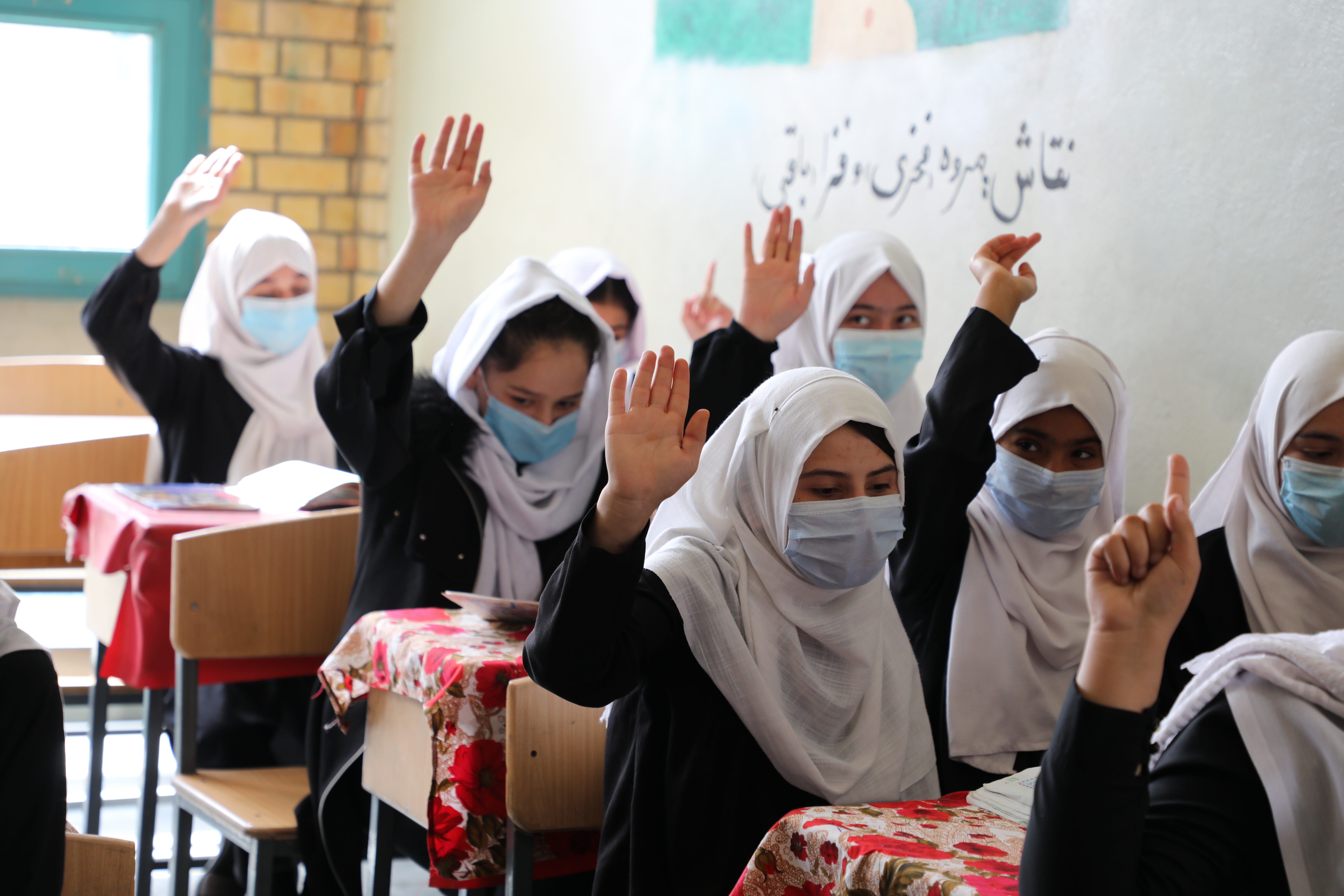
No other regime has displayed as much opposition and resistance to the education of girls in the face of demands from both the locals and the global community as the Taliban has - they are persistent in banning girls from studying above the primary grades (Human Rights Watch, 2023).
For around two and a half years since the closure of secondary schools for girls, the regime has offered no valid reason, only vague references to the so-called religious and cultural claims (Amnesty International, 2023; Human Rights Watch, 2023 & USIP, 2022). When pressed for specifics, they retreat into silence. Promises of a resolution have been unreal, with rumors of commissions and proposals that never materialize (Wilson Center, 2022; Gannon, 2022).
The de-facto regime's retort to those demanding equality in education has been brutal and unequivocal: threatened, punished, and forced into exile. The demonstrators faced severe repercussions; many were aggressively pursued and incarcerated, others were coerced into silence through threats, and a number found themselves compelled to escape the country (United Nations, 2023; Amnesty International, 2023; Human Rights Watch, 2022).
Amid this turmoil, it is crucial to examine the layers of the Taliban's rationale. Before discussing their current policy arguments, we must understand the values at the core of their ideology about women. Since the start, the Taliban have been clear about their ideology. They assert the superiority of men and deny women equal rights. This ideology guided their actions during their rule from 1996 to 2001. It also guided them during their insurgency and in their recent return to power (Sahill, 2023). According to this ideology, women are confined to domestic tasks. Only in rare cases, such as being doctors, nurses, or sometimes police officers, can they work outside the home.
This ideological value underpins their key policies, including those on education. The Taliban propose several arguments to justify their stance. One argument suggests that Afghanistan is not ready for female education. It draws parallels with Iran. Iran suspended education after its revolution. De facto regime sympathizers often echo this stance. They seek to deflect from the current crisis by citing history. They advocate for patience and gradualism (Hussein, 2023).
A second, more politically charged argument hinges on international recognition. Some supporters of the de-facto regime propose that the West's acknowledgment of the Taliban regime could incentivize them to reconsider their stance on female education. This approach, however, equates human rights to a bargaining chip in geopolitical negotiations.
The most compelling argument, rooted in historical evidence and scholarly analysis, points to a deep-seated ideological conviction within the Taliban as an ideological movement. This ideology, which predates the regime's establishment, opposes female education on fundamental grounds, revealing a continuity of extremist beliefs that have influenced policy since the reign of Amanullah Khan at the beginning of the 20th century and persisted through the Taliban (Froght & Rajath, 2022; Yazadin, 2020). It has an apparent reason to recognize modern education for girls as a phenomenon conflicting with their interests in society and a shaking power to their core interests.
The intertwining of extreme religious thoughts with political power has erected formidable barriers to girls’ education. As religious hardliners consolidated power, their ideological opposition to female education solidified, surviving and adapting through Afghanistan's tumultuous history (Olesen, 1995; Adamec, 1970).
The Taliban's ideology, which equates female education with secular values, remains deeply rooted. The Taliban's leadership has made it clear on several occasions that this is the first time in history that their doctrine has state power, and they intend to wield it uncompromisingly.
The historical path, over two decades of the Taliban’s policy on girls' education, and pronouncements from the group's leaders underscore a crucial point: the debate over girls' education is far from simple or direct. The resistance stretches beyond a mere prohibition, extending to a multifaceted control over female education's various aspects and dimensions.
References:
Adamec, L. (1970). Emergence of Modern Afghanistan: Politics of Reform and Modernization, 1880–1946 (Stanford, California, Stanford University Press, 1969). Pp. 586.Index. International Journal of Middle East Studies, 1(4), 372-374. doi:10.1017/S0020743800000763
Amnesty International. (2023, May 26). AMNESTY INTERNATIONAL AND INTERNATIONAL COMMISSION OF JURISTS JOINT PRESS RELEASE Embargoed until 00:01 BST on 26 May 2023 Afgha. Amnesty International. Retrieved January 10, 2024, from https://www.amnesty.org/en/wp-content/uploads/2023/05/English-Press-Release-.pdf
Frogh, R., & Rajath, D. V. (2022). Women education in Afghanistan: A historical perspective. Asian Journal of Research in Social Sciences and Humanities, 12(6), 162-173.
Gannon, K. (2022, March 23). Taliban break promise on higher education for Afghan girls. AP News. Retrieved January 10, 2024, from https://apnews.com/article/afghanistan-education-kabul-taliban-dcdc0ba6768213009f69cc6e284d7f52
Human Rights Watch. (2022, October 20). Afghanistan: Women Protesters Detail Taliban Abuse. Human Rights Watch. Retrieved January 10, 2024, from https://www.hrw.org/news/2022/10/20/afghanistan-women-protesters-detail-taliban-abuse
Human Rights Watch. (2023, March 24). One Year On, the Taliban Still Attacking Girls' Right to Education. Human Rights Watch. Retrieved January 10, 2024, from https://www.hrw.org/news/2023/03/24/one-year-taliban-still-attacking-girls-right-education
Hussein, M. (2023, September 4). Taliban urges 'patience' on women's education – Middle East Monitor. Middle East Monitor. Retrieved May 20, 2024, from https://www.middleeastmonitor.com/20230904-taliban-urges-patience-on-womens-education/
Olesen, A. (1995). Islam and politics in Afghanistan. Curzon.
Sahill, P. H. (2023, May). Dwelling in an all-male world: A critical analysis of the Taliban discourse on Afghan women. In Women's Studies International Forum (Vol. 98, p. 102748). Pergamon.
United Nations. (2023, July 17). Human Rights situation in Afghanistan: May - June 2023 Update | Department of Political and Peacebuilding Affairs. Department of Political and Peacebuilding Affairs. Retrieved January 10, 2024, from https://dppa.un.org/en/human-rights-situation-afghanistan-may-june-2023-update
USIP. (2022, April 1). Taliban's Ban on Girls' Education in Afghanistan. United States Institute of Peace. Retrieved January 10, 2024, from https://www.usip.org/publications/2022/04/talibans-ban-girls-education-afghanistan
Wilson Center. (2022). AfPak File: The Taliban's Broken Promise On Girls Education. Wilson Center. Retrieved January 10, 2024, from https://www.wilsoncenter.org/audio/afpak-file-talibans-broken-promise-girls-education
Yazdani, H. (2020). History of Formal Education and Influence of Politics in Afghanistan. In Factis Pax: Journal of Peace Education and Social Justice, 14(2), 120-139.