

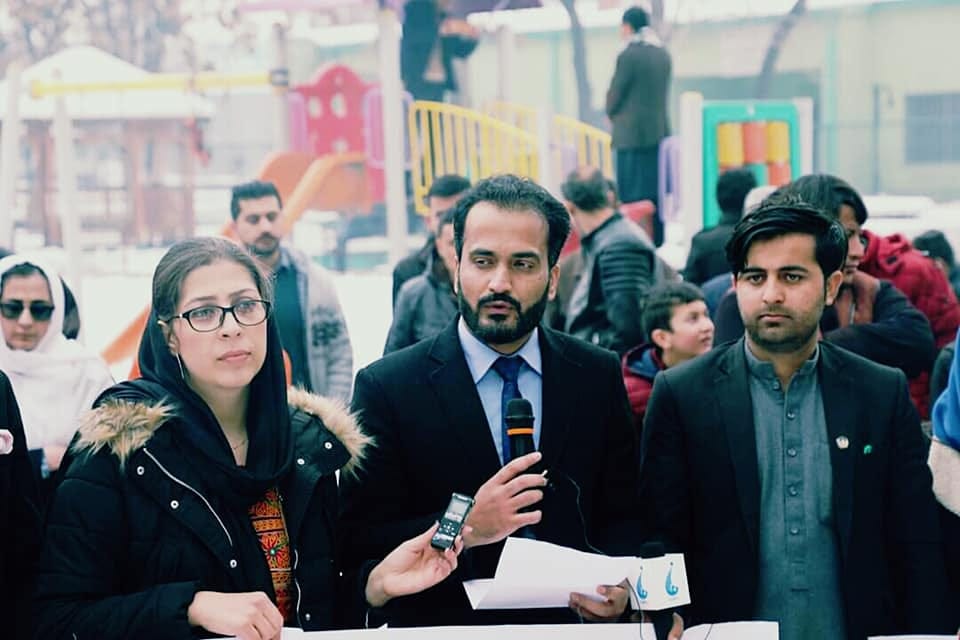
Photo: Kabul, Afghanistan, March 2019. The author and civil society colleagues called for clear guarantees on women’s rights as peace negotiations with the Taliban commenced—warnings that were unfortunately overlooked.
When Taliban negotiators arrived in Doha for peace talks, there was a surge of optimism. Abbas Stanikzai, the group’s chief negotiator, made significant promises: under Taliban governance, girls would be allowed to pursue education up to the doctoral level. For a nation weary from four decades of conflict, these assurances were impactful. Afghan peace delegates, international mediators, and many in the public were inclined to believe that the Taliban of 2020 was fundamentally different from the regime that previously closed girls’ schools and enforced brutal punishments against women from 1996 to 2001.
However, not everyone was convinced. Within Afghan civil society, a more critical assessment was taking place. Those of us who had examined the Taliban’s ideology — beyond just their tactics — recognized that their opposition to female education was not merely a policy that could be changed. It was a deep-seated ideological conviction, rooted in their interpretation of Islamic law and their vision of a society where men and women occupy distinctly separate roles: men in public life and women confined to the home. Given that the core beliefs of the Taliban had not changed in 25 years, why would a shift in political circumstances alter their ideological stance?
I publicly raised this concern. In the winter of 2019, during peace negotiations between the Afghan government and the Taliban, I joined fellow civil society activists in a demonstration in Kabul. Our demand was straightforward: considering the Taliban’s documented history of systemic gender discrimination, any peace agreement must include legally binding guarantees for women’s rights — particularly the right to education. We were not against peace that would protect human rights and freedom; we advocated for accountability and human dignity. This distinction was crucial, though often overlooked amid the political discourse.
Our concerns were largely dismissed. Some members of the Afghan political establishment, including those on the Republic’s negotiating team, viewed civil society voices as obstructive, even as threats to peace. In hindsight, this response is understandable: many in the delegation seemed more focused on securing power in a post-agreement landscape than on protecting rights. The Taliban, for their part, navigated the negotiations skillfully, providing assurances designed to satisfy international observers while committing to nothing enforceable. Consequently, the vital question of what rights Afghan women would retain under a future Taliban-influenced government was sidelined.
The Taliban’s return to power in August 2021 clarified the situation. Within days of taking Kabul, they banned girls from secondary schools, impacting over one million girls who had completed primary education or were enrolled in higher grades. For many, this was shocking. For those of us in civil society who had closely examined Taliban ideology, it was expected. It confirmed what historical and scholarly evidence had long indicated: the Taliban’s opposition to female education is not a reactive policy but a proactive ideology, upheld with strong commitment since their establishment in 1996.
Understanding the Ideology
To understand the Taliban’s stance on girls’ education, it is essential to look beyond 2021 and even 1996, focusing instead on the movement’s ideological foundations. The Taliban’s worldview is significantly shaped by Deobandi Islamic thought, a reformist tradition from 19th-century colonial India, along with the extremist dynamics resulting from the wars and conflicts of the 1980s and 1990s. Within this context, female education, especially co-educational or secular schooling, is viewed not only as unnecessary but also as a threat to social order, political power, and religious integrity. This viewpoint is resistant to negotiation or gradual reform, reflecting deeply held theological and political beliefs.
Research supports this interpretation. Scholars like Dyan Mazurana and Elizabeth Stites have documented the Taliban’s consistent application of gender-segregated norms across both their first and second regimes, highlighting the ideological continuity that persists despite tactical adjustments for international audiences. Similarly, Antonio Giustozzi’s work on Taliban politics shows that the movement’s leadership has remained ideologically consistent on gender issues, even while internal debates have emerged on military strategy or governance. The promises made in Doha were not evidence of ideological change; they were a strategic negotiation tactic.
Ongoing Suppression
Since August 2021, the Taliban have not only maintained their ban on girls’ secondary and higher education but have also systematically expanded their repressive measures. Through numerous decrees, they have restricted girls’ access to non-formal learning, limited online education, and imposed sweeping ideological changes at the primary level affecting all students. Boys’ education has also been affected: curricula have been stripped of critical thinking, civic education, human rights, and cultural pluralism, replaced with Taliban doctrine. Libraries and bookstores have been purged of disapproved materials, and educational environments have been realigned with Taliban ideology.
The Taliban have significantly altered the labor market, making secular education less advantageous for the future. Female employees have been dismissed from almost all government sectors, and private sector employment for women is largely prohibited across most industries. For men, advancement within the Taliban’s state apparatus increasingly depends not on academic qualifications but on religious credentials and ideological loyalty. Graduates from Taliban-aligned madrassas, who receive doctrinal training alongside their religious education, are favored for government roles. In contrast, university graduates find their qualifications devalued in a system that prioritizes ideological alignment over merit. The message is clear: secular modern education has no future in Taliban-controlled Afghanistan.
Political theorists differentiate between authoritarian regimes, which seek compliance, and totalitarian ones, which aim for conversion. Hannah Arendt’s analysis of totalitarianism is relevant here: such governance not only controls behavior but also seeks to reshape consciousness, eliminating independent thought. The Taliban’s education policies fit this model. The ban on girls’ schooling is not merely a discriminatory act; it is part of a broader ideological project aimed at creating a society where the Taliban’s radical interpretation of religion is not only enforced but internalized from an early age through education.
A Broader Warning
Afghanistan’s experience has implications that extend beyond its borders. The Taliban model — characterized by systematic gender-based exclusion from education, ideological control of curricula, and economic restructuring to reward doctrinal conformity — serves as a coherent and replicable framework. In fragile states where radical movements are gaining power and state institutions are weakening, Afghanistan offers a template that others may observe and emulate. The international community’s failure to foresee, prevent, or effectively counter the Taliban’s education policies should prompt serious reflection on the assumptions that guide engagement with extremist movements in peace processes.
Seven years have passed since the winter demonstration in Kabul, and the developments have unfolded as civil society had warned. The key takeaway is not only that pursuing the peace process was misguided, but also that it proceeded without enforceable rights guarantees. Such a process, as we witnessed in Afghanistan, cannot lead to genuine peace and instead creates opportunities for systematic human rights abuses. The Taliban did not change their position on girls’ education after 2021; they simply made it clear. The evidence—historical, ideological, and empirical—has always been available for those willing to look.
The question now is not whether the Taliban will change, but whether the world will finally stop expecting them to.
References
Arendt, H. (1951). The Origins of Totalitarianism. Harcourt Brace.
Giustozzi, A. (2008). Koran, Kalashnikov, and Laptop: The Neo-Taliban Insurgency in Afghanistan. Columbia University Press.