

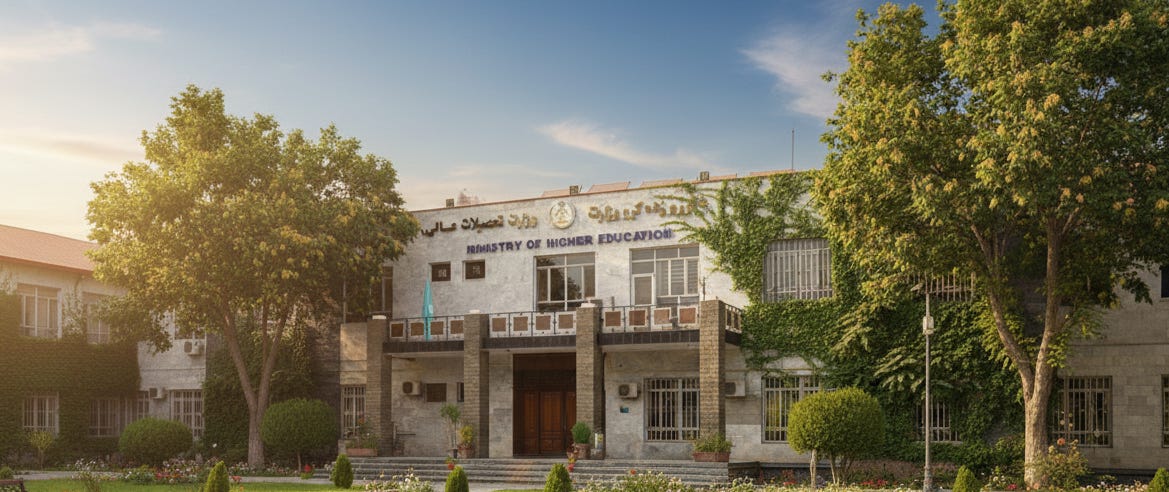
The Taliban’s Minister of Higher Education, a close confidant of their supreme leader, has become notorious for his hostility toward academic freedom, modern scientific inquiry, and critical thought. His worldview mirrors, almost verbatim, the ideology of the Taliban’s supreme leader. For those who rely solely on surface-level media reports to understand this position, a careful reading of the Taliban’s Law on the Promotion of Virtue and Prevention of Vice provides a more direct entry point into their ideological foundation.
This law is heavily grounded in religious justifications, but specifically those stemming from the most radical schools of thought. It must be acknowledged that Islam has always contained multiple interpretive traditions, and across its history, scholars have debated, disagreed, and provided a wide range of opinions. These interpretations extend from moderate, reformist views to hardline extremist ones. The Taliban leadership and its senior officials, however, consistently select and institutionalize the most rigid and extremist readings.
The Law on the Promotion of Virtue and Prevention of Vice is the clearest illustration of the Taliban’s ideological choice to impose a gender-segregated and authoritarian social order. It codifies fundamentally different sets of rights and liberties for men and women, institutionalizing a sharp division between the public and private spheres. Men are assigned authority and responsibility for all matters outside the household—encompassing political, economic, and civic domains—while women are legally and physically confined to the domestic sphere. Placed firmly under the supervision of male guardians, women are denied the right to education, employment, freedom of movement, and participation in public life.
The enforcement of this vision is delegated to the Ministry for the Promotion of Virtue and Prevention of Vice (PVPV). The law explicitly empowers its enforcers (muhtasibīn) to monitor daily life, issue prohibitions, and mete out punishments for transgressions. Their mandate is sweeping: prohibiting social interaction between unrelated men and women, policing women’s dress and conduct, restricting contact between Muslim and non-Muslim women, and barring women from appearing in public without a mahram. Article 13 of the law defines “sharia hijab” as full-body covering, and Article 20 requires transport providers to refuse service to any woman not wearing such attire or traveling without a male guardian.
The scope of the law extends beyond gender restrictions to encompass cultural life more broadly. Article 22 lists “wrongful acts” to be eradicated, including men shaving their beards below a fist’s length, listening to music in homes or vehicles, and observing cultural festivals such as Nawruz or Shab-e Yalda. It also prohibits “making or possessing pictures or videos of animate beings on mobile phones, computers, or other devices.” This provision not only bans photographs and art but also underpins broader restrictions on visual representation, leading to the removal of images from government websites, universities, and public spaces.
In effect, the law establishes a state-supervised regime of moral policing. It strips women of agency, erodes cultural traditions, and suppresses ordinary social freedoms. By outlawing images, music, and mixed-gender sociality, it seeks to create a society governed by surveillance and enforced conformity. The provisions are not symbolic: they are tied to concrete enforcement powers that allow PVPV agents to inspect institutions, businesses, and even private homes. Universities, for example, have been ordered to eliminate images, expel women, and submit to regular inspections by religious police.
The result is not merely a restriction of rights but the legal entrenchment of a totalitarian vision in which Afghan society is remade through coercion, surveillance, and the suppression of diversity in religious and cultural expression.
In this context, the Minister of Higher Education—an extremist figure closely aligned with the supreme leader—has spearheaded the implementation of these principles within universities. His policies represent not only an immediate threat to higher education institutions (HEIs) but also a long-term danger to the intellectual and social fabric of Afghanistan.
Since imposing the PVPV, the minister has ordered the removal of all photographs from the Ministry of Higher Education’s website, including his own. More recently, he instructed universities to erase images, logos, and sculptures of human figures, as well as those symbols deemed incompatible with Taliban policies. In addition, he authorized religious police to enter university campuses to inspect and enforce compliance with the PVPV.
Underlying these measures is a deep antagonism toward modern education itself. On multiple occasions, the minister has explicitly opposed girls’ and women’s education, going so far as to suggest that the ban may be permanent. He claims there is no religious basis—within their selective interpretation—for allowing Afghan girls to attend schools. Soon after taking office, he abruptly barred women from universities, even in the middle of annual examinations.
His arguments are rooted less in technical or policy reasoning and more in ideological conviction. The minister persistently emphasizes the need to “re-doctrinate” Afghan youth with the Taliban’s ideological framework. In a recent speech at a madrasa in Kabul, he expressed open distrust of university students, portraying them as dangerously vulnerable to secular thought and anti-Taliban sentiment transmitted via social media and the internet. He divided society into three categories: elders unfamiliar with technology, religious actors who defend the Taliban’s ideology, and HEI students who, he claimed, are susceptible to “enemy brainwashing.” From this perspective, he has pushed, reportedly, for banning smartphones in universities and has supported broader restrictions on internet access.
Despite his efforts, the minister is acutely aware that technology and the free flow of information make it increasingly difficult for the Taliban to fully control or indoctrinate students. This recognition has become a source of concern for Taliban leadership, as it threatens the social engineering project entrusted to the higher education sector.
The impact on HEIs has been profound. Universities are being reshaped into sites of indoctrination, yet the pace of change has not met the Taliban’s expectations. Their ambition is to achieve full conformity within one or two years, with students and institutions embracing their ideology wholesale. Incremental progress is dismissed as insufficient—they demand immediate and total compliance, which has so far eluded them.
The policies now imposed on Afghanistan’s universities, grounded in the PVPV, are not temporary measures. The Taliban’s leadership has demonstrated its determination to use every available mechanism—excluding women from education, banning images of living beings, suppressing academic freedom, and dismantling institutional autonomy—to force universities into alignment with their ideological agenda. They recognize, more than anyone else, that coexistence between their version of religion and globally recognized norms of rights and liberties is impossible. It is this irreconcilability that drives their uncompromising policies in higher education and beyond.