

Ask the literature when Afghanistan’s education system was at its best, and it will point to a specific era, a decade, or a reform. However, it has not tested that claim on a larger scale — a continuous measure of access from 1912 to 2021. This short piece does.
Two historical periods often referenced for educational achievement are the Amanullah-era reforms of the 1920s and the development decades of the 1950s–60s. These periods are cited as examples of increased access. However, neither claim has been tested against the actual rates.
The data does not support these claims. In 1927, the peak year of the Amanullah reforms, the out-of-school rate was 97.4%. By 1965, the last observed year in the second cited era, the rate was 92.3%, also a reported value rather than an interpolated one. Throughout both periods, the rate never fell below 92% at any observed point. This means that during the years typically considered the country’s strongest, at least nine out of ten school-age children were excluded from the system.
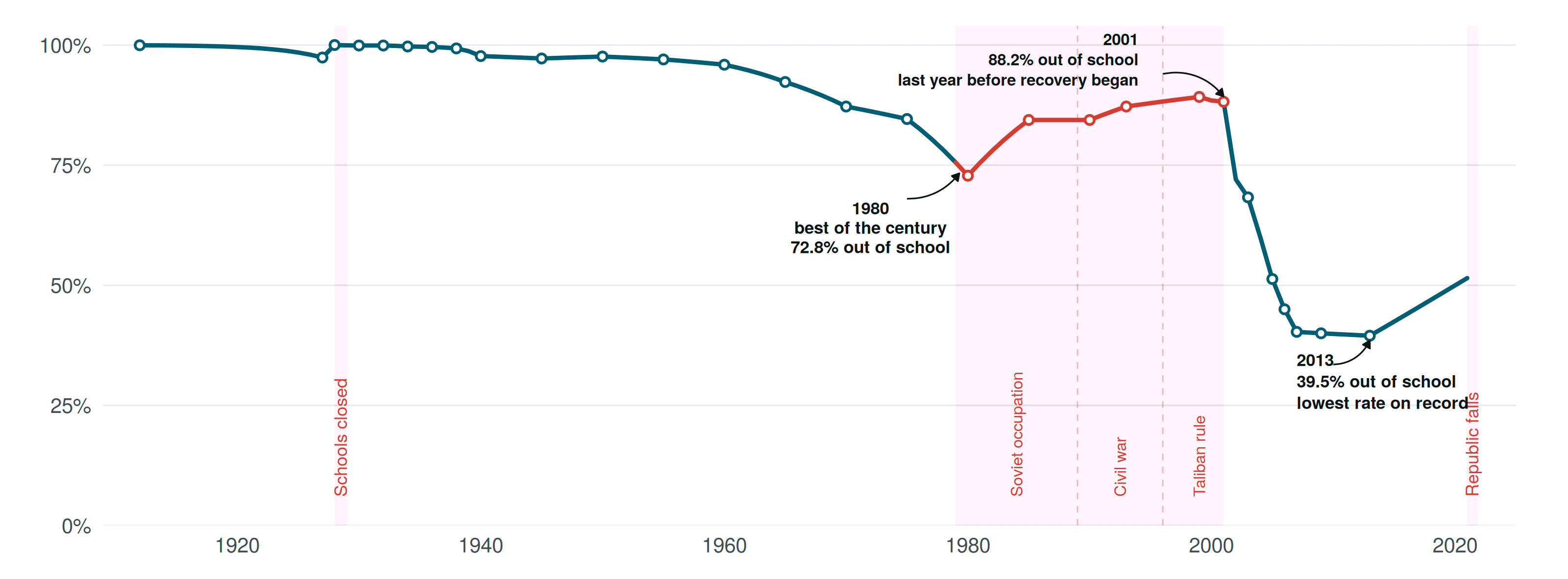
This establishes the analytical framework for the discussion ahead. The performance of an education system can be understood in at least two ways. The basic definition emphasizes the system’s role in providing access, while the broader definition also considers quality indicators, such as instructional standards, retention rates, and learning outcomes.
Examining the historical graph through the basic definition reveals that Afghanistan has never had a public education system that ensured all children attended school. Even at the lowest recorded rate of 39.5% in 2013, nearly two in five school-age children were still outside the system. The gender gap is particularly striking: by 2012, Afghanistan’s Gender Parity Index for primary enrollment was the lowest in the world.
This situation prompts a more complex inquiry than the graph alone can address: what went wrong, and why did the significant international assistance in the 2000s and 2010s fail to achieve universal access?
It is crucial to highlight a key limitation in understanding this issue: national figures, including the graph above, obscure significant provincial disparities. Progress was not uniform. Provinces that started with a stronger foundation made the most gains, while the weakest provinces largely stagnated. This resulted in divergence rather than convergence over time. Gender disparity is the most notable aspect of this issue, affecting every province and period in the data, but it is not the only factor. This is the same error the golden-era myth made, repeated on a smaller scale: mistaking a single number for the whole picture. A century of data shows how many children were out of school. It does not yet reveal which children, in which province, and that is where the harder work begins.