

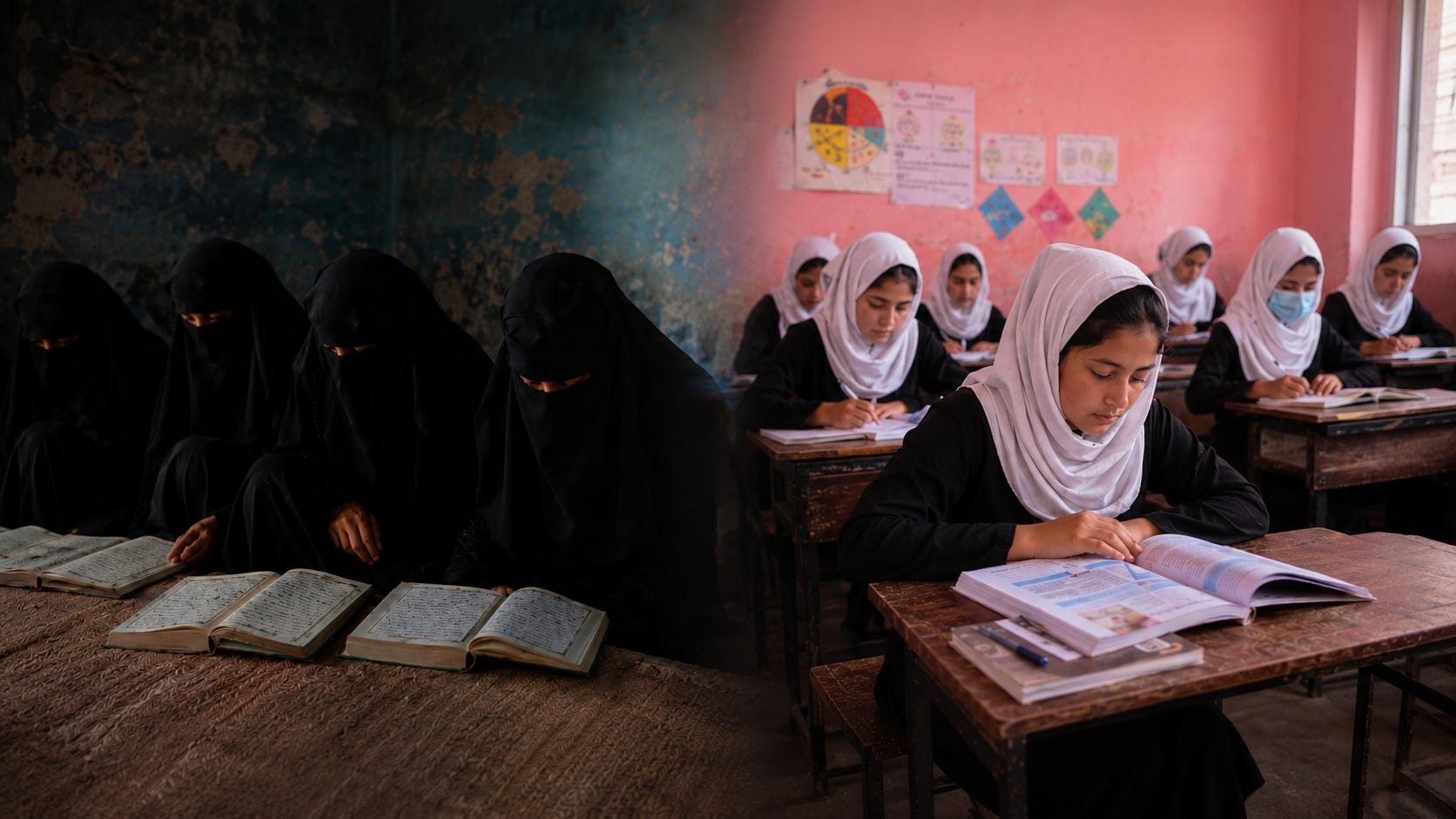
Photo: Two contrasting representations of Afghan female learners are shown: the madrassa-centered model of religious instruction is on the left, while the formal school model of modern public education is on the right.
Introduction and Central Argument
Madrasas, which focus on religious instruction, differ fundamentally from modern schools in their purpose, curriculum, and teaching methods. The increase in madrasas in Afghanistan since 2021 should not be viewed as a natural growth of religious education in a devout society or as a revival of longstanding traditions; this perspective must be approached with caution, as the visible trends may suggest otherwise. Instead, this growth represents a state-led initiative aimed at ideological goals. Under Taliban, the expansion of madrasas serves as a key tool for solidifying the regime, resulting in a deliberate restructuring of the educational landscape. This effort is not intended to strengthen religious education alongside modern schooling but rather to blur the lines between the two systems, aiming to bring the broader education framework under the madrasa’s influence.
This restructuring unfolds along two parallel pathways. On one hand, both public and private schools face restricted access, limited growth, and ideological redefinition. Their curricula are increasingly stripped of social sciences, humanities, philosophy, and civics—elements that have traditionally set them apart from religious institutions—while what remains aligns with Taliban interpretations of Islam. Conversely, madrasas are expanding more rapidly, bolstered by state-funded dormitories, formal credentialing pathways, and direct employment opportunities within the state. Inside the public education system, only a limited range of technical subjects continues to operate with some autonomy, focusing on the regime’s practical needs and lacking the political or intellectual content the Taliban seeks to suppress.
The argument presented here is that this situation does not represent a neutral convergence but rather a layered, asymmetric transformation. Both ends of the educational spectrum—madrasas on one side and public and private schools on the other—are being deliberately shaped by policy toward a single ideological center defined by the regime. The Taliban’s madrasa policy can be best understood as the establishment of a framework for ideological indoctrination, a system through which the regime’s preferred subjects are produced, categorized, and integrated into the state. The numerical data supports this interpretation. According to the reports, since 2021, approximately 85 madrasas have been established for each new public school, with registered madrasas exceeding 21,000 compared to roughly 18,000 public and private schools combined; the regime has also announced plans to establish between one and ten madrasas in every district. These figures indicate not a balanced expansion of educational opportunities but a deliberate reversal of the traditional roles of madrasas and modern schools within the national education system—an issue that requires urgent scholarly and policy attention.
Indoctrination at the Core of Institutional Design
A recurring analytical oversight in discussions about Taliban education policy is the focus on indoctrination at the curriculum level—specifically what is taught in individual lessons—rather than considering the institutional structure. This perspective is insufficient, as the structural changes taking place provide a broader context in which curricular changes are one important aspect among many. To fully understand Taliban educational policy, it is essential to start at the structural level rather than concluding there. Scholars of totalitarian education emphasize that the ideological function of an educational system is less about any single textbook and more about the structural organization of credentials, examinations, teacher recruitment, institutional prestige, and recognized pathways to social mobility. A more fruitful inquiry, therefore, examines who is authorized to teach, which credentials facilitate state employment, which institutions are permitted to expand or contract, and how social mobility is currently enabled.
From this perspective, the Taliban’s policy appears as a well-planned and systematic program rather than a series of isolated decisions. The issue is not merely that religious instruction is now reaching a broader segment of Afghan children; rather, the institutional framework of modern education—public schools, universities, teacher-training academies, and examination bodies—is being restructured to align with religious institutions under direct regime control. UNAMA’s April 2025 report characterizes this shift as the “conversion of the public education system into a madrassa system” and the “gradual replacement of educated technocrats in line ministries with religiously educated clerics loyal to the Taliban movement” (UNAMA, 2025). Similarly, the Special Inspector General for Afghanistan Reconstruction, in its October 2023 report to the U.S. Congress, found that the de facto authorities had begun removing secular subjects from curricula at all levels and converting teacher-training facilities and schools into madrasas across several provinces (SIGAR, 2023).
The Pre-2021 Baseline: The Education System and Societal Demand
To grasp the significance of the post-2021 shifts, it is essential to carefully establish the pre-Taliban baseline. Data from the National Statistics and Information Authority (NSIA) from 2016 to 2021 reveal that Afghanistan’s educational system maintained a structural distinction between general and formal religious education. However, this distinction should not be overstated; the curriculum in general public schools was not entirely secular, as it included Islamic religious instruction as a mandatory subject across all grades. Thus, Afghan general schools were not secular institutions in the strictest sense; they were public institutions that integrated religious content alongside a modern curriculum. Within this framework, the two sectors operated at scales suited to their distinct social functions.
Despite facing well-documented challenges such as quality issues, corruption, insecurity, and uneven access, the general education sector was expanding to meet pressing developmental needs. The number of general schools grew from 15,709 in 2016 to 17,780 in 2021, while student enrollment increased from 8,755,955 to 9,966,496. This expansion was driven by structural necessity rather than ideological motives; a country like Afghanistan requires millions of literate citizens and a skilled workforce—teachers, physicians, engineers, civil servants, and technicians—and only a mass public schooling system can provide that workforce at the necessary scale.
Formal religious education, which includes madrasas, Darul Hifaz, and Darul Uloom, functioned at a scale that matched its narrower social purpose. The number of institutions remained stable during this period (1,048 in 2016 and 1,038 in 2021), with enrollment fluctuating between approximately 300,000 and 380,000. This profile indicates a sector that is neither in decline nor suppressed by state policy; rather, it reflects a sector that is appropriately sized to meet the actual societal demand for formal religious training: stable, specialized, and operating within a transparent and regulated framework.
This baseline is analytically significant for two reasons. First, it demonstrates that during the final years of the Republic, the two sectors did not compete for the same students or social functions; they addressed different needs at scales appropriate to those needs and coexisted within a single education system that was neither strictly secular nor exclusively religious. Second, it counters a justification available to the de facto authorities and some sympathetic observers: the claim that post-2021 madrasa expansion addresses a latent religious demand previously suppressed by the former government. The data do not support this interpretation. There is no discernible trend in the 2016–2021 figures that would, if projected, lead to the institutional shift observed since 2021. The post-2021 expansion does not reflect an unmet societal preference or a continuation of any visible trend prior to the regime change. Instead, it represents a rupture: the imposition of a new institutional framework by a regime intent on reshaping the educational landscape contrary to the calibration achieved by the previous system.
The Mechanism of Flattening: Convergence as Policy
Understanding the asymmetry in this restructuring is crucial: the environment in which madrasas are expanding is not a static modern school system; it is actively being reshaped to facilitate that growth. This process is directional and uneven. Modern schools are increasingly losing subjects—such as civics, social sciences, philosophy, and the humanities—that have historically set them apart from religious instruction. Meanwhile, modern educational credentials, including undergraduate, master’s, and doctoral degrees, are being extended to madrasa graduates without any reciprocal recognition. This piece analyzes this trajectory through three sequential processes, highlighting the disparity between the evolving modern schools and the unchanged madrasas.
First, modern schools are being stripped of the subjects and pedagogies that have historically defined them. The curriculum is being diminished as civics, social sciences, philosophy, and the humanities are removed, with critical-thinking pedagogies being narrowed or reframed within a religious context. The October 2023 report from the Special Inspector General for Afghanistan Reconstruction to the U.S. Congress indicated that the de facto authorities have begun eliminating secular subjects at all educational levels, shifting curricula toward Taliban-interpretive Islamic studies (SIGAR, 2023). UNAMA has characterized this curricular change as part of a broader transformation of the public education system into a madrasa system (UNAMA, 2025). The remaining subjects in the modern curriculum—mathematics, natural sciences, and a limited range of technical topics—are preserved primarily because they fulfill the regime’s need for engineers, medical professionals, and technicians, while lacking the political or intellectual content the regime aims to suppress. The pressing question is what happens to the other subjects: the social, civic, humanistic, and historical content removed from schools is not disappearing but is being replaced by material aligned with the Taliban’s preferred religious and ideological framework—sometimes through new content and sometimes by increasing the share of existing religious subjects.
Second, this substitution does not represent a transfer of content from one sector to another. The civic, humanistic, social, and historical material removed from school curricula is not being transferred to madrasas, and madrasa enrollment is not designed to provide these subjects in any recognizable form. The substitution occurs within the schools themselves. The space once occupied by history, civics, ethics, and the humanities is not being filled with reworked versions of those subjects but is being reduced and replaced with content that aligns with the regime’s preferences: historical material is being simplified and reframed to position the Taliban as the legitimate inheritors of Afghanistan’s past; civic education, human rights, and gender equality topics are being narrowed or replaced with Taliban interpretations of jihad, governance, gender, and obedience. Where limited opportunities for non-religious material exist—such as English and basic mathematics in some private madrasas for wealthier families—they do not indicate a parallel modernization of the religious sector. Most madrasas, including those funded by the de facto authorities and many supported by charitable networks, remain predominantly religious in nature. These minor concessions are best viewed as a thin veneer that conceals the substantive direction of policy, where subjects with familiar names—like “history,” “social studies,” and “ethics”—are increasingly presenting the regime’s self-portrayal.
Third, the credentialing framework is being restructured, but not through a neutral unification of the two sectors. Madrasa graduates are increasingly receiving secular credentials from the modern education system—at the undergraduate, master’s, and doctoral levels—through examination and certification processes managed by the Islamic Education Department of the Ministry of Education and the Ministry of Higher Education. Holders of these credentials are now occupying senior and managerial roles across various state sectors, including customs, traffic administration, economic affairs, agriculture, and media oversight, areas that traditionally require specialized technical training but which the regime prefers to staff with ideologically aligned individuals. UNAMA’s April 2025 report on the Promotion of Virtue and Prevention of Vice law describes this trend as the “gradual replacement of educated technocrats in line ministries with religiously educated clerics loyal to the Taliban movement,” framing it within a broader governance strategy aimed at consolidating the regime’s political authority (UNAMA, 2025). The flow is one-directional: madrasa credentials are gaining access to positions historically reserved for graduates of schools and universities, while the value of modern school credentials is diminishing and receiving no equivalent acknowledgment within religious institutions or the state.
Collectively, these three processes illustrate a flattening that is neither balanced nor complete and does not operate in both directions. The modern school is being compelled to shift toward the madrasa rather than vice versa: its curriculum is being emptied, and the vacated space is being filled with content from the regime’s preferred religious and ideological canon; its credentials are being awarded to madrasa graduates without reciprocal recognition; and its institutional standing within the state is eroding. In contrast, the madrasa remains structurally unchanged—it is not absorbing modern subjects nor being transformed into a different institution but is instead being elevated as the benchmark against which the modern school is being evaluated and reshaped. Some aspects of this design are already in operation, others are being implemented gradually, and some are outlined in the regime’s published plans yet to be executed. What is evident is the clear direction of this development: an apparatus of ideological indoctrination is actively being constructed, rather than a system of religious education in any conventional sense.
The Gendered Dimension: Madrasas as the Sole Tolerated Pathway
The situation described above is occurring in a context where an entire demographic—girls and young women beyond grade six—has been entirely excluded from secondary and tertiary education. UNESCO estimates that since 2021, around 1.5 million girls have lost access to secondary schooling, with approximately 80 percent of school-age girls and young women currently out of formal education (UNESCO, 2023). In this environment, madrasas are not just one option among many; for many girls and their families, they represent the only post-primary pathway permitted by the de facto authorities. According to the same UNESCO report, by 2023, about 95,000 girls and young women had enrolled in religious schools, including over 20,000 in government-run madrasas, with subsequent data showing a continued increase.
Mirbacha’s (2025) grounded-theory study on girls transitioning from public schools to madrasas describes this decision as a “forced choice.” Faced with the prospect of leaving education entirely, girls and their families turn to madrasas, but this choice is influenced by the same restrictive conditions: prior schooling is not always recognized equivalently, the curricula offered are narrower than those available to boys, infrastructure is inconsistent, and instruction tends to focus more on promoting regime-approved norms than on fostering intellectual growth. This gendered aspect of the restructuring is not incidental but fundamental. The unequal shift from schools to madrasas, coupled with the complete exclusion of girls from the former, creates a group of young women whose only approved avenue for organized learning is through an institution explicitly designed to reinforce the regime’s moral and ideological framework.
The Comparative Argument and Its Limitations
Proponents of engagement with the Taliban’s education system may argue that madrasa-based education can coexist with modern educational objectives. This perspective references, among others, the UNESCO’s 2024 policy brief on madrasa systems in Bangladesh, Indonesia, Malaysia, Egypt, and Singapore, which illustrates that faith-based Islamic education can fit within a pluralistic educational framework when regulated by the state, aligned with a general curriculum, inclusive of girls, and connected to competencies needed for contemporary labor markets. This observation holds empirical validity in those contexts and merits consideration.
A counter-argument to the position presented in this piece comes from Rahimi and Muhammad Din’s (2024) study, which draws on thirty-five key informant interviews with students, teachers, and administrators from madrasas across seven Afghan provinces. Their research examines the current state of madrasa education under Taliban rule and explores whether these institutions can serve as a platform for Afghan women to assert their agency as equals deserving of dignity and free inquiry. Citing Saba Mahmood’s analysis of Islamic women’s agency in non-Western contexts, the authors suggest that female madrasa attendance can be seen as a form of negotiation and quiet resistance to the regime’s extreme patriarchy. They argue that women are leveraging these institutions, designed to confine them, to gain interpretive authority within the religious framework that legitimizes the regime’s rule. This argument deserves a careful response rather than dismissal. Engaging with it is methodologically important; a thesis like the one presented here is strengthened through sustained engagement with scholarship that challenges its conclusions, and the literature on contemporary Afghan education benefits from dialogue between differing perspectives.
In response, I contend that the empirical evidence gathered by Rahimi and Muhammad Din ultimately does not support the optimism of their interpretation. The institutional context they describe, regardless of how adeptly their interviewees navigate it, does not align with the comparative cases that underpin their argument. This discrepancy becomes evident when their evidence is assessed against the three institutional conditions established in the literature on integrated madrasa systems.
First, the comparative cases rely on a specific institutional foundation: a state that enforces academic standards, ensures equal access for girls, and recognizes madrasa credentials within a broader, predominantly secular labor market. Rahimi and Muhammad Din acknowledge that the Indonesian model often cited in this literature relies on a configuration where women have political rights, full access to education, freedom from Purdah-based mobility restrictions, and the active support of state-backed Islamic feminist movements. They note that this contrasts sharply with the situation for women in Afghanistan. The Pakistani case similarly falls short, as the gradual integration of Pakistani madrasa graduates into the broader credentialing system occurred under competitive pressure from general education and literacy, with female enrollment in formal examinations rising alongside religious education. Such dynamics are absent in Afghanistan, where the regime has prohibited women from general education beyond grade six, dismantled connections between religious credentials and the broader labor market, and, as documented by Rahimi and Muhammad Din, excluded female madrasa graduates from most government jobs, even within the religious sector.
Second, the comparative cases position madrasas as one option within a plural educational landscape. The Afghan context has eliminated this plurality, as evidenced by the interview material collected by Rahimi and Muhammad Din. A female student in rural Kabul states that “most girls go to madrasas because they have no choice.” Teachers and students across their sample repeatedly express that if schools and universities were open to women, the enrollment rate in madrasas would significantly decrease. Even female madrasa teachers, whose positions might seem strengthened by current trends, express concern that the redirection of girls into religious studies will result in a shortage of female doctors and nurses in the coming years. These voices reflect not an integrated system where madrasa attendance represents a meaningful choice but a population for whom alternatives have been systematically removed.
Third, the comparative examples present madrasas as tools for expanded access, designed to incorporate marginalized groups into the broader educational system. In contrast, the expansion of madrasas in Afghanistan serves a different purpose. Rahimi and Muhammad Din document that personnel in the new state apparatus are primarily drawn from the ulama and madrasa networks; the prospect of state employment is the main incentive for male students entering the religious sector, and the institutional framework has been restructured to channel religiously credentialed men into positions of authority. Women, even those with the same credentials, remain excluded from this pathway. Consequently, what is being institutionalized is not access as understood in the comparative literature, but the development of an ideologically aligned cadre within an authoritarian framework, alongside the diversion of women into a separate educational track with no equivalent route into public life.
It is noteworthy that the authors of the counter-argument themselves acknowledge some of these points. Rahimi and Muhammad Din conclude their study by emphasizing that female madrasas cannot serve as an acceptable substitute for general education for Afghan girls and women, reporting that their interviewees, both teachers and students, called for the reopening of general education. Thus, the disagreement between this piece and their analysis is narrower than it may initially seem; it revolves around the interpretive weight assigned to agency exercised under conditions of severe constraint. The comparative cases supporting the engagement argument illustrate pluralism, complementarity, and expanded access; the Afghan case, even when generously interpreting the experiences of its female students, reveals the systematic removal of those essential preconditions. Applying the conclusions of the first set to the second amounts to imposing a framework on a context from which its foundational conditions have been deliberately stripped away.
Conclusion: The Thesis and Its Stakes
This piece presents an institutional argument rather than a doctrinal one. It asserts that under the Taliban, the growth of madrasas occurs within a coercive policy environment characterized by the prohibition of girls’ secondary and tertiary education, the ideological reshaping of the existing curriculum, the unequal recognition of madrasa graduates within the state, and the positioning of religious institutions as the primary source of education. This combination has transformed religious education, within the specific institutional framework established by the regime, into a tool for state-led ideological reconstruction.
What sets this development apart from the gradual institutional changes typically expected from a religiously radical regime is the speed of its implementation. In less than five years, the Taliban have nearly quadrupled the number of registered madrasas, established religious institutions at about eighty-five times the rate of general schools, replaced humanities and social sciences in schools with content aligned to their ideological preferences, expanded the religious sector significantly more than the schools sector, and integrated madrasa graduates into key state functions. The UN Special Rapporteur on human rights in Afghanistan has warned that this trajectory deprives Afghan children of essential knowledge and skills for contemporary life and risks fostering extremist views, noting that madrasas and other informal pathways “cannot fill the gap” left by the closure of formal education for girls (Bennett, 2024; JURIST, 2025).
Thus, the thesis of this piece, along with the historical analysis provided earlier, is clear: the Taliban’s expansion of madrasas since 2021 should not be interpreted as a natural progression of religious education in a devout society or a revival of longstanding traditions. Instead, it should be seen as a state-directed initiative for ideological formation, wherein the distinctions between modern schools and madrasas are intentionally being blurred. This boundary is not evolving into a workable pluralism, as seen in the comparative cases discussed; rather, it is collapsing asymmetrically, with general schooling being reshaped to align more closely with madrasas. The exclusion of girls from formal education leaves a generation of young women with limited options for organized learning, confined to institutions designed to reinforce the regime’s moral framework. The rapid pace and direction of this restructuring, coupled with the increasing difficulty of reversing it over time, necessitate not only scholarly attention but also urgent engagement from researchers, multilateral institutions, and policymakers.
References
Afghanistan International. (2025, January 28). Taliban’s jihadi madrassas have dangerous impact on minds of youngsters, says new study. https://www.afintl.com/en/202501286648
Afghanistan de facto Ministry of Education. (2025). Key achievements of the Ministry of Education. Kabul: De facto Ministry of Education.
Bennett, R. (2024). Report of the Special Rapporteur on the situation of human rights in Afghanistan (A/79/330). United Nations General Assembly. https://www.ohchr.org/en/documents/country-reports/a79330-report-special-rapporteur-situation-human-rights-afghanistan
JURIST. (2025, February). UN expert expresses concern over worsening human rights situation in Afghanistan. https://www.jurist.org/news/2025/02/un-expert-expresses-concern-over-worsening-human-rights-situation-in-afghanistan/
Mirbacha, P. (2025). From maktab to madrassa: Afghan girls and the forced choice — A grounded theory study of girls’ transitions from public schooling to religious education in Afghanistan after 2021. Raoul Wallenberg Institute of Human Rights and Humanitarian Law. https://rwi.lu.se/wp-content/uploads/2025/09/Palwasha-Mirbacha-report-2024.pdf
Rahimi, H., & Muhammad Din, F. (2024). Female madrasas and Islamic agency of Afghan girls and women: How religious education is being used by Afghan women and girls under the Taliban regime. Manchester Journal of Transnational Islamic Law & Practice, 20(3), 101–118.
Special Inspector General for Afghanistan Reconstruction. (2023, October 30). Quarterly report to the United States Congress. SIGAR.
United Nations Assistance Mission in Afghanistan. (2024). Report of the Secretary-General on the situation in Afghanistan (A/78/914–S/2024/469). https://unama.unmissions.org/sites/default/files/sg_report_june_2024.pdf
United Nations Assistance Mission in Afghanistan. (2025, April). Report on the implementation, enforcement and impact of the Law on the Promotion of Virtue and the Prevention of Vice in Afghanistan. https://unama.unmissions.org/sites/default/files/unama_pvpv_report_10_april_2025_english.pdf
UNESCO Kabul. (2024). Policy discussion brief: Key elements of madrasa education in selected countries — What lessons can be drawn for Afghanistan? UNESCO. https://articles.unesco.org/sites/default/files/medias/fichiers/2024/09/02.Madrasa_Education_in_selected_countries.PDF
UNESCO. (2023). Afghanistan: Let girls and women learn! UNESCO. https://www.unesco.org/en/articles/unesco-dedicates-2023-international-day-education-afghan-girls-and-women