

The curriculum for social subjects was recently reviewed by a Taliban-appointed committee within the Ministry of Education, composed of the Deputy Minister of Islamic Studies, the Deputy Minister for Quality Assurance, the Deputy Minister of Financial and Administrative Affairs, and the Deputy Minister of Education and Training. According to the committee, the revisions were carried out to align the curriculum with Sharia law and Taliban policies.
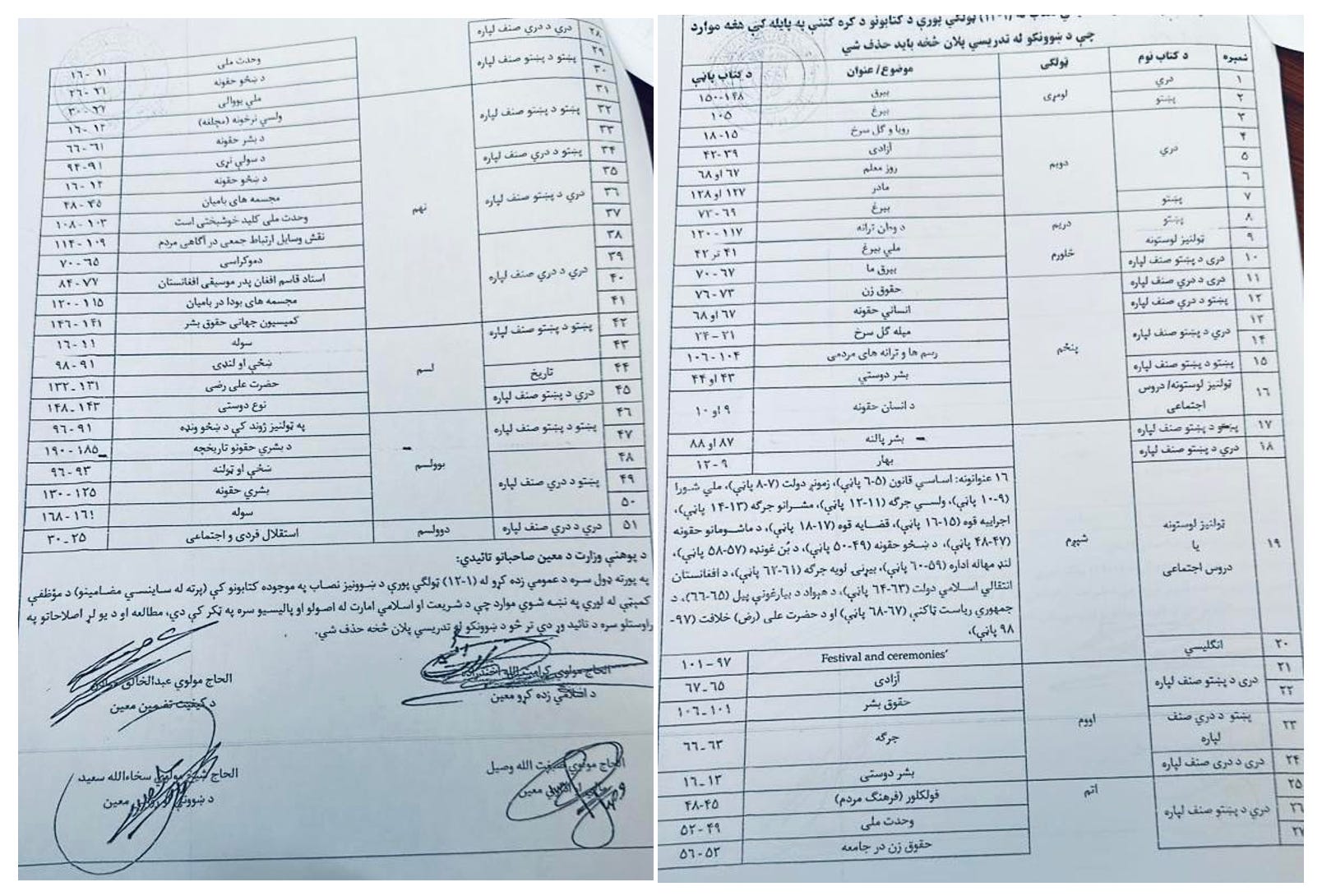
This week's decision on the list of topics banned from the school curriculum.
The scope of these revisions is extensive: they affect 51 subjects, representing the majority of social science materials from grades 1 through 12, and result in the removal of nearly hundreds pages of content. This constitutes the second major wave of curricular changes. The first occurred in 2022, when entire subjects such as Constitution, Civic Education, and Human Rights were eliminated and replaced with religious content, including the introduction of explicitly ideological material such as Jihad.
Although the Taliban initially planned to rewrite the entire curriculum, financial and logistical constraints—including the prohibitive costs of new textbook production and distribution—have slowed this process. The Taliban’s Minister of Education has publicly complained about the lack of international support for printing new textbooks and has suggested that external donors demanded the removal of “Jihad” from the curriculum as a precondition for assistance. In response, the current strategy has shifted toward a more incremental—though still sweeping—approach: systematically reviewing existing subjects and excising or altering specific content deemed incompatible with Taliban ideology.
Under this second wave of changes, entire categories of knowledge are being removed. Topics such as women’s rights, human rights, equality, freedom, democracy, constitutionalism, cultural pluralism, critical inquiry, and global outlook have been removed. In conceptual terms, this amounts to the deliberate elimination of all discourse related to rights, liberties, equality, and civic participation—an outcome entirely consistent with the Taliban’s laws and policies, which explicitly reject the principles of equal rights and democratic governance.
The ban extends beyond predictable categories such as human rights. For instance, International Teacher’s Day has been eliminated. The Taliban’s underlying position, conveyed implicitly through their curricular revisions, is that only religious teachers, or those under their direct supervision, should be recognized as legitimate educators. These figures, in their framework, must not be equated with secular teachers, as they are set apart by a distinct and elevated role. Acknowledging International Teacher’s Day would therefore suggest extending respect and legitimacy to educators outside Taliban control—something their policies seek to withhold.
Similarly, topics such as peace—crucial in a country scarred by decades of conflict—have been eliminated. In their place, the Taliban promote the doctrine of violent Jihad, which directly contradicts the notion of peace as a civic or moral value. Museums glorifying military artifacts and narratives of violent struggle underscore this shift.
Equally significant is the removal of topics on mass communication and public awareness in the subjects. In a country where communities are geographically and socially fragmented, such topics would have introduced students to the role of communication in building social cohesion and problem-solving. For the Taliban, however, independent communication and civic mobilization are unacceptable. Public discourse is to be monopolized by the state; civil society, political parties, and independent institutions are already banned.
The topics on traditional Afghan institutions such as the Jirga—historically central to governance, conflict resolution, and community representation—are also excluded. The Taliban seek to replace this centuries-old participatory mechanism with state-controlled religious councils, thereby dismantling community-based governance structures and consolidating power in a rigid top-down model. Likewise, cultural forms of expression such as poetry, drawing, and national anthems are restricted. The Taliban emphasize that their religious anthems played a decisive role in mobilizing fighters and sustaining morale during the insurgency. Precisely because they recognize the power of such symbolic tools, they now seek to monopolize the entire domain of collective expression.
Community-produced anthems, and cultural symbols—forms through which people articulate independent meanings and identities—are regarded as potential threats and eliminated from the curriculum, since they might generate narratives that counter Taliban ideology. For this reason, the institution of the anthem, like other cultural symbols, is being brought firmly under Taliban control. Among the few formal laws issued recently is a the Regulation of Poetry Recitation Gatherings Law, which explicitly prohibits any criticism of Taliban policies. By extending regulation to cultural and artistic expression, the Taliban demonstrate their intent to dominate not only knowledge production in education but also the broader symbolic sphere of Afghan society.
Even the celebration of Spring and Nawroz, which symbolize renewal and cultural continuity, is prohibited in the curriculum as it contradicts the Taliban’s ideological agenda.
These curricular changes are not isolated incidents but part of a broader campaign of ideological engineering. In recent weeks alone, nearly 679 subjects around 90% of the total subjects—primarily in the social sciences and humanities—have been removed. This curricular purge has been accompanied by repression: civil activists who criticize the changes have been detained, teachers’ and students’ associations have been dissolved, and educators who challenge Taliban policy face severe punishment. In one case, a school principal was sentenced to death for speaking on the value of modern education. Parallel restrictions on media and speech further reinforce this silencing.
Taken together, these measures provide compelling evidence that Afghanistan is rapidly moving toward a religious totalitarian system. This system rejects pluralism, equality, and critical thought in favor of indoctrination, obedience, and militant ideology. In place of human rights, democracy, and cultural diversity, students are now taught a fictitious narrative built on violence and the systematic erasure of Afghanistan’s civic and cultural heritage.