

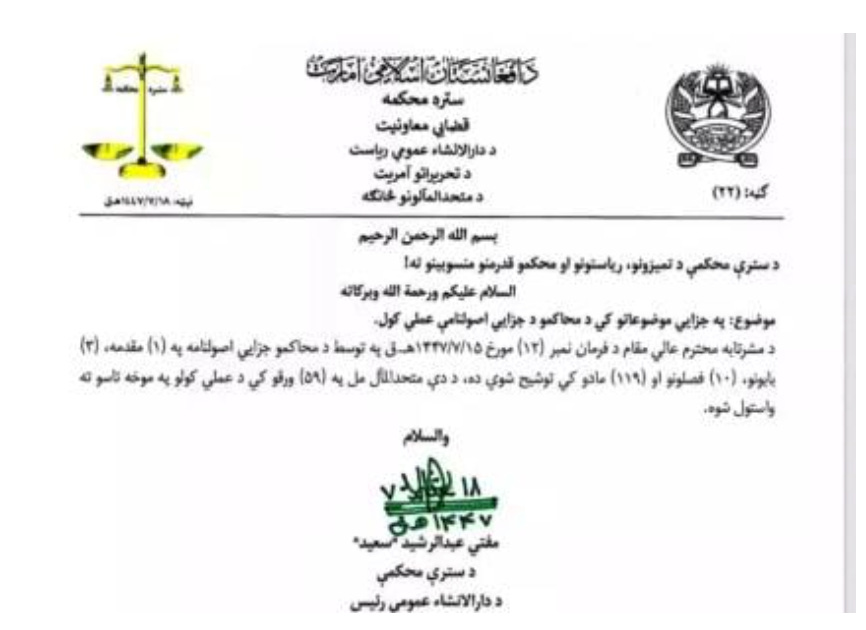
The Taliban’s newly introduced criminal code serves not just as a legal framework but also aims to reshape Afghan society through hierarchy, coercion, and institutionalized inequality. It deviates from fundamental principles of equal citizenship, due process, and legal accountability, creating a tiered system of rights and responsibilities that reinforces gender-based discrimination, restricts freedom of expression, and permits harsh penalties, including capital punishment. In this context, the law does not function to limit power or address harm; instead, it acts as a tool of authoritarian governance that imposes suppression, normalizes surveillance, instills fear for compliance, and redefines social relations around subjugation rather than rights.
Structurally, the Taliban’s Criminal Code of Conduct comprises ten chapters and 119 articles, enforced alongside Sharia-based norms primarily derived from Hanafi jurisprudence. In practice, the system operates through a dual normative regime. When conduct is alleged to be criminal, authorities first assess whether it constitutes an offense under Sharia, regarded as divine and superior law. If the act does not fall within explicit Sharia prohibitions, adjudication shifts to taʿzīr, a domain of discretionary punishment framed as human-legislated regulation. This structure reflects a deliberate hierarchy of legal legitimacy, positioning Sharia as the ultimate normative authority while employing taʿzīr as a flexible tool for regulating a wide array of behaviors.
In terms of scope, Sharia is typically invoked concerning personal morality and a limited set of public-order offenses. Conversely, a broad spectrum of conduct that modern legal systems would generally classify as criminal—particularly behavior related to governance, social regulation, and political control—is adjudicated through taʿzīr. Under the Taliban, this discretionary domain has been effectively codified, making taʿzīr the primary mechanism for governing daily life. The penal framework thus operates through the interplay of two sources: Sharia provisions and the taʿzīr-based criminal code, supplemented by additional regulations with lesser normative authority. Within this hierarchy, the criminal code represents the highest authority among man-made laws, to which all other regulations must conform.
Importantly, this penal order is not based on equal legal status or reciprocal rights and obligations. Instead, it institutionalizes differentiated legal standing through two intersecting regulatory frameworks. The first is Sharia adjudication, which—despite claims of universality—operates on gender-differentiated assumptions that lead to systematically unequal outcomes for men and women. The second is the criminal code itself, which explicitly categorizes individuals and assigns unequal punitive consequences based on social and political position. As a result, identical actions can yield drastically different outcomes: some groups may face no punishment at all, while others endure severe and disproportionate penalties. Thus, punishment is determined not only by the offense but also by the offender’s position within the regime’s constructed hierarchy, leading to selective criminalization.
Beyond stratified punishment, the code governs society through ambiguity, intrusion, and ideological enforcement. Indeterminate offenses—such as assisting “corrupt” individuals or engaging in undefined oppositional behavior—are paired with harsh penalties, allowing for selective enforcement while maintaining an appearance of legality. The code intrudes deeply into private and social life, criminalizing everyday actions like eating during Ramadan, interacting with a non-mahram woman, or criticizing Taliban officials. Even children are not exempt: the code permits physical punishment as long as it does not result in broken bones or visible injury, effectively legalizing violence as a governing method.
The penal framework also criminalizes dissent and pluralism. Insulting Taliban leaders, criticizing policies, or disagreeing with Taliban-approved religious scholars can lead to imprisonment or flogging, insulating those in power from accountability and criminalizing independent thought. Religious conformity is enforced through sanctions against deviation from Hanafi jurisprudence, transforming theological differences into criminal liability. Thus, the law extends beyond regulating conduct to governing belief itself, marginalizing religious minorities and suppressing alternative interpretations of Islam.
A significant feature of this framework is the mandatory reporting obligations, which effectively recruit ordinary citizens into the regime’s enforcement apparatus. The code criminalizes not only prohibited actions but also the failure to report dissenting opinions or oppositional behavior, shifting legal responsibility from individual wrongdoing to loyalty. This represents a considerable departure from established justice principles, redirecting focus from individual accountability to enforced adherence to political authority. By penalizing non-participation in coercive governance, the code institutionalizes collective surveillance, erodes social trust, fragments community cohesion, and subjects daily life to extensive political scrutiny. The resulting penal logic is explicitly political, aimed at disciplining society, enforcing conformity, and suppressing independent civic engagement.
Emerging signs indicate a stratified Afghan society organized according to the three hierarchical categories defined by the new legal framework. At the top are Taliban officials and religious clerics; below them are wealthy and influential ethnic leaders; and at the bottom is the broader population. This hierarchy is not just symbolic—it manifests in daily life. In social gatherings, private events, and even access to public services, those in higher tiers receive preferential treatment. What was once informal social deference has now become institutionalized. Social prestige and privileged access are viewed not as temporary advantages but as legally recognized entitlements.
In summary, the Taliban’s criminal code establishes a coherent system of control built on class-based impunity, collective surveillance, ideological enforcement, and legalized inequality. These components do not constitute a justice system; rather, they create a governing model in which legality expands state power, normalizes arbitrary punishment, and ranks individuals according to their status and utility to the regime. Under this system, impunity increases with power while punishment intensifies for the vulnerable. Afghanistan is not being offered justice through law; it is being subjected to law as a means of domination.